


What are RAL Codes and Painting Line (CCL)?
RAL codes are standardized color codes created by RAL (Reichs-Ausschuß für Lieferbedingungen und Gütesicherung), a subsidiary of the German Institute for Quality Assurance and Labeling. Thanks to these codes, it has become easier to make the right choice in works such as printing and coating, by assigning a special number to each color.
Before the invention of this system, customers had to find another sample or similar of this color and present it to the manufacturers in order to express the color they wanted. With the introduction of a standard for colors, it is up to customers and manufacturers to specify the code of the color they want.
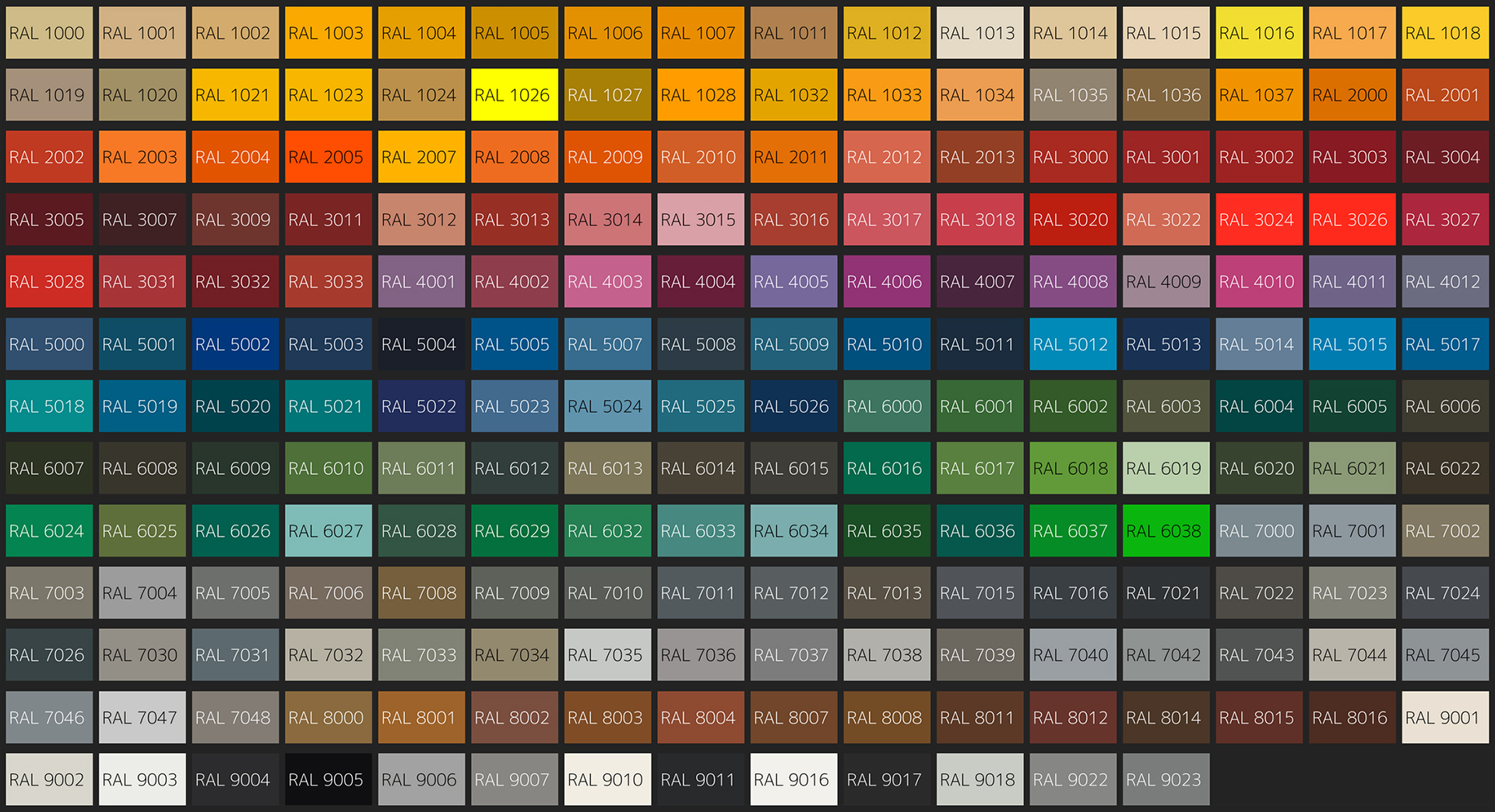
RAL Classic
The first codes created in 1927 included a collection of 40 colors. Thanks to the color tones added to the collection since then, the number of colors increased to 213 in 1961. These codes are still in use today.
The RAL Classic colors are written using a 4-digit number along with the letters ”RAL”. The system works as follows
RAL Design
By 1993, a new color matching system was created, adapted to the needs of architects, designers and advertisers. This new system, called the RAL Design collection, contains 1,625 colors. The system works as follows;
The figures are grouped in threes and two pairs. The first three-digit number represents the main characteristic of the color, the first even number represents the lightness (hue), and the second even number represents the perceived color. For example, the color code of the dark blue color is expressed as RAL 270 30 20.
In addition to RAL Classic and RAL Design, there are 4 different RAL color code systems in total, including RAL Effect, which consists of 420 colors based on water-based paint systems, and RAL Plastic, which consists of colors determined for plastics. Incoming steel painting requests are carried out in accordance with the RAL catalog.
CCL (Painting Line) and Painting Process
Painting line (CCL) is a line where all metals are painted in different colors according to customer demands and different textures are processed on the steel surface. Paint applications can be increased up to 200 micron thicknesses in line with customer demands, taking into account the properties of the paint. Ünallar Metal’s painting line, which was established entirely with domestic and national facilities, has the capacity to perform the thinnest painting process in Turkey with 0.20mm.
Paint application is standard in the form of 5 micron primer and 20 micron polyester on the top layer, top coat, and 7-8 micron epoxy polyester or epoxybackcoat, suitable for the lower surface. If requested, the protective film can be coated. Painting processes to be carried out by Ünallar Metal are carried out in accordance with RAL codes in line with the wishes of our customers. In cases where the desired color is not available in the RAL catalog, we produce these colors specially.
In our line, which we have created with local and national facilities, we also carry out imitation and lacquer applications that will make a difference especially in the field of architecture. With these applications, we process textures such as wood and marble on the steel, adding aesthetics to the strength of the steel.
For your galvanized sheet metal painting processes, you can get more detailed information on our website, and you can reach our officials at unallar@unallarmetal.com.